
Some updates on the New Philadelphia Archaeology Project.In early January, 2008, we received funding from the National Science Foundation's Research Experiences for Undergraduates program for another three years of field school research at New Philadelphia, which is planed to start in the summer of 2008. The daily archaeological work in this field school will be co-directed by Dr. Anna Agbe-Davies (DePaul University), Dr. Terry Martin (Illinois State Museum), and Chris Fennell (U. Illinois). Additional information and applications for this field school is available online at:http://www.histarch.uiuc.edu/NSF/fieldschool.html
Other planned projects in 2008 include continuing work towards nominating the New Philadelphia town site and nearby features of the cultural landscape for National Landmark status, an effort headed up by Ms. Charlotte King and Prof. Paul Shackel, Director for the Center of Heritage Studies at the University of Maryland. Ms. King has also authored an excellent lesson plan based on the history of New Philadelphia as part of the National Park Service's Teaching with Historic Places program, available online at:http://www.nps.gov/history/nr/twhp/wwwlps/lessons/130newphila/index.htm.
Graduate students at the University of Illinois, Urbana-Champaign are working with Chris Fennell to enhance our mapping and landscape studies of the town site and surrounding area, and to expand our analysis of archival data from nineteenth century newspapers published in the region. Terry Martin and his colleagues at the Illinois State Museum continue their work of analyzing artifacts and faunal remains excavated at the town site.We are now working on publishing a collection of articles in a specially edited issue of a peer-review journal and are at work on other articles and books. Our findings and interpretations to date are currently scheduled to be published in an official monograph series reviewed and published by the Illinois State Museum. This publication series, entitled the "Illinois State Museum Reports of Investigations," utilizes ISM and external peer reviewers, and has previously published studies by distinguished scientists such as Patty Jo Watson, Melvin Fowler, Jane Buikstra, and George Milner. In addition, we have a specially edited, thematic issue of articles on New Philadelphia under review with "Historical Archaeology," the peer-reviewed journal of the Society for Historical Archaeology.In June, 2007, Chris Fennell, Tommy Hailey (Northwestern State University in Louisiana), and Bryan Haley (University of Mississippi), received approval of a grant from the National Center for Preservation Technology and Training to conduct a low-altitude aerial survey of the New Philadelphia town site using a high resolution thermal camera to look for subsurface anomalies that may correlate with archaeological features. We plan to conduct the aerial survey during one week in the Spring of 2008, and to then process the data after completing the aerial survey. The timing for conducting the aerial survey depends upon a variety of logistical concerns and contingencies that include ground cover conditions and periodic rainfall conditions. Additional details about this survey are available online at:http://www.diaspora.uiuc.edu/news0907/news0907.html#12
Sunday, January 27, 2008
Monday, October 23, 2006
New Philadelphia and Free Frank
We are so excited about this special produced for ABC7 Chicago by Janet Davies. You can go here to watch the video. It is great.
Friday, August 04, 2006
A big step forward ...
THERE was a major event at New Philadelphia Thursday afternoon, nicely reported by The Quincy Herald-Whig.
 From left, facing a group of reporters, are Philip Bradshaw, president of the New Philadelphia Association, Sen. Emil Jones, president of the Illinois State Senate, and Sen. Deanna Demuzio, who announced a state grant of $125,000 to the Association for town site acquisition and development.
 From left, facing a group of reporters, are Philip Bradshaw, president of the New Philadelphia Association, Sen. Emil Jones, president of the Illinois State Senate, and Sen. Deanna Demuzio, who announced a state grant of $125,000 to the Association for town site acquisition and development.
Saturday, July 29, 2006
Recording the finds ...
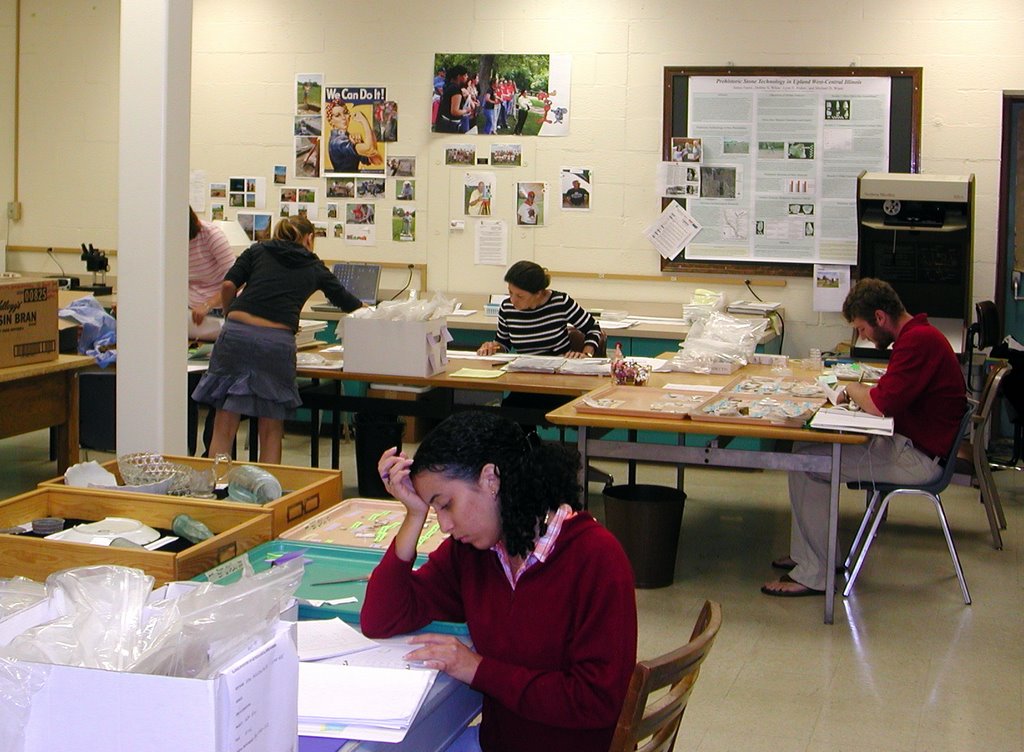
Students in this photo are at work in the Illinois State Museum Collection Center analyzing and recording items discovered during the Summer 2006 archeological dig at New Philadelphia, work done under the auspices of a National Science Foundation grant.
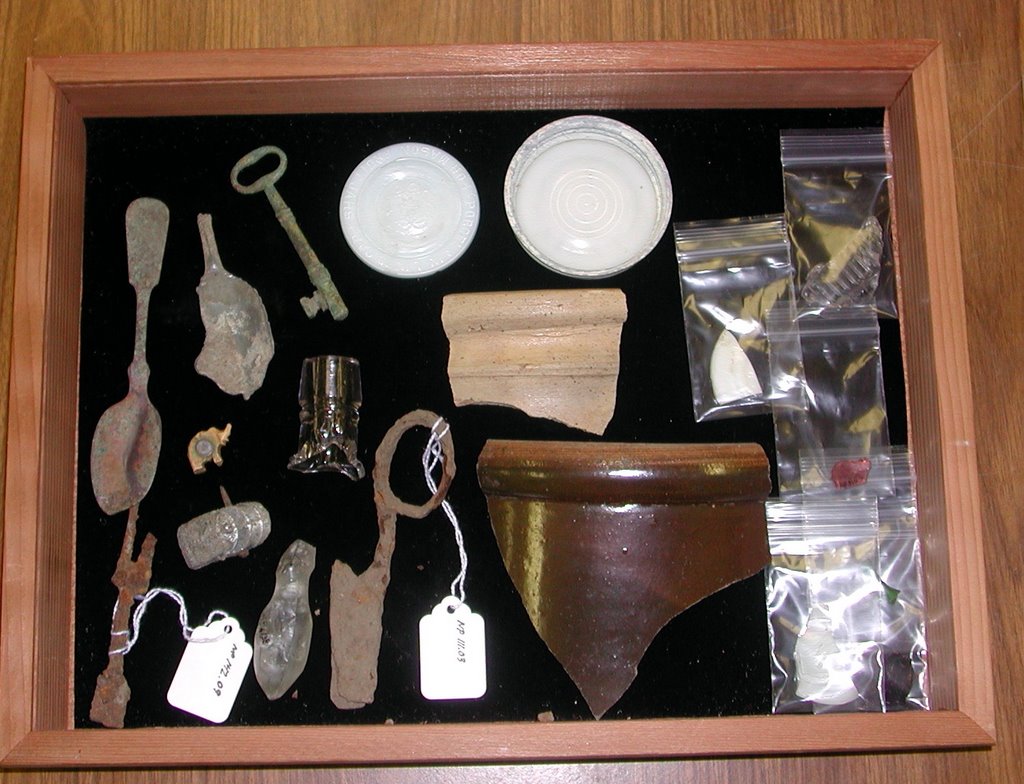
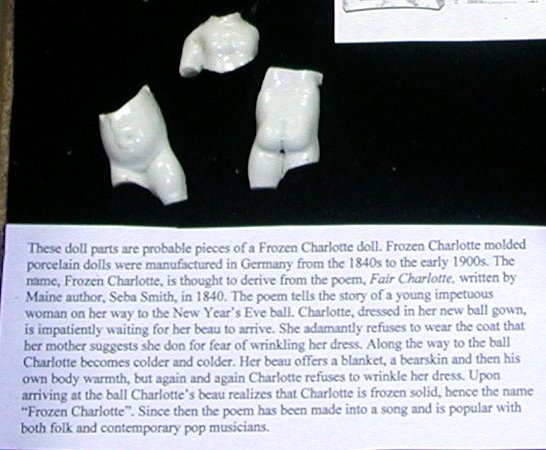
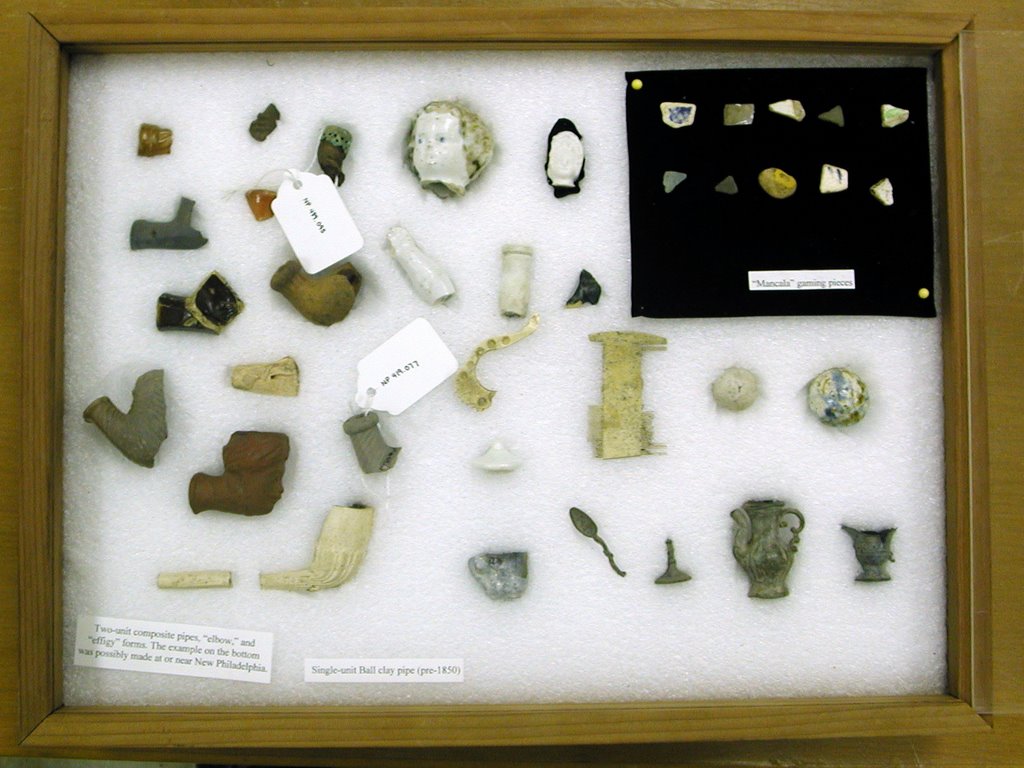
Photos below show some of the items found this summer
Friday, July 14, 2006
From the L.A. Times ...
Read P.J. Huffstutter's article on New Philadelphia in the July 14 issue of the Los Angeles Times: "A Land of Racial Harmony?" (Yes, you will have to register and it's free.)
Tuesday, June 20, 2006
More photos ...
Two more photos from last week's activities:
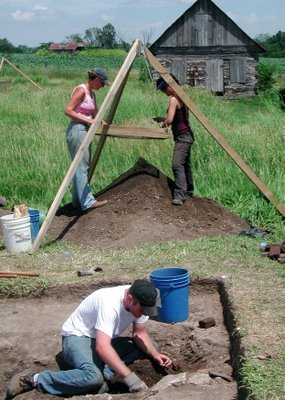
Jason digs while fellow students sift soil for small artifacts.

Sandra McWorter Marsh and Claire Martin, standing left, speak to an opening reception for the June 17, 2006 Family History Workshop.

Jason digs while fellow students sift soil for small artifacts.
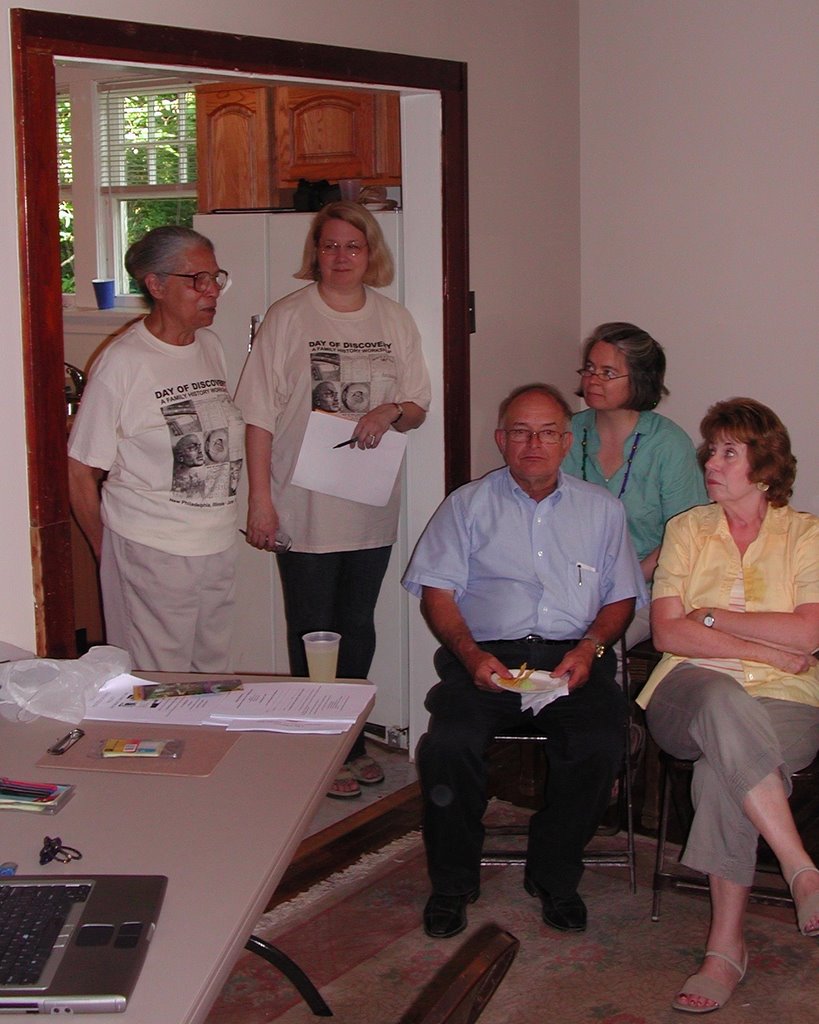
Sandra McWorter Marsh and Claire Martin, standing left, speak to an opening reception for the June 17, 2006 Family History Workshop.
Monday, June 19, 2006
A busy weekend ...
There was much activity at the New Philadelphia site the weekend of June 16-17, 2006. The third summer of archeological work was continuing and a family history workshop was held at the Burdick Conference Center at the site. Here's a photograph of the foundation the student archeologists revealed:


Wednesday, April 19, 2006
Quincy Herald Whig
Snapshots in time: 'Faces of New Philadelphia' offers peek into town's past, present
Wednesday, April 19, 2006
By Deborah Gertz Husar
Herald-Whig Staff Writer
HANNIBAL, Mo. — Lucy McWorter's dark eyes pierce the visitor from the photograph, seemingly inviting a closer look into her world.
A nearby photo shows a field school student sifting fill at New Philadelphia, working to unearth more of the story of the community established by McWorter's husband, Free Frank McWorter, in 1836.
Images from the past juxtapose with images of today in "Faces of New Philadelphia," an exhibit of photographs sponsored by the New Philadelphia Association in conjunction with Hannibal-LaGrange College and the Illinois State Museum.
The exhibit opened Tuesday night and continues through April 28 in the main lobby of the Burt Administration Building on the HLG campus.
The 14 photographs feature "not only the people working on it now, but the people there in the past, archaeologists, New Philadelphia Association members, interested visitors who might be descendants and faces taken from artifacts," said Terry Martin, Illinois State Museum curator of anthropology.
New Philadelphia Association Vice President Natalie Armistead said the exhibit will be expanded and will be available to travel to colleges, libraries, businesses and other sites.
"It's a way to get out to places where the public can see the faces of what we're finding," she said.
"I grew up with this, but it's nice to share," said Sandra McWorter, a great-great-great-granddaughter of Free Frank who lives in Chicago.
It's also essential to stage the exhibit in Missouri, "a very important state for the McWorter family," McWorter said. Free Frank "founded the town in Illinois, but from the time that happened, it was a continuous move west. It's the American story."
One of Free Frank's grandsons, who held patents on flying machines in 1914, was living in St. Louis, while other descendants settled in Kansas City, where McWorter graduated from high school, and other communities.
A photo collage featured in the exhibit shows Free Lucy, descendants and, possibly, Free Frank.
"We don't know we actually have a photo of Free Frank. We think we do," Armistead said.
Free Frank bought his wife's freedom in 1817, his own in 1819 and eventually for 14 family members.
"It's a love story, the most beautiful I ever read," New Philadelphia Association member Pat Likes said.
———
What was New Philadelphia?
* New Philadelphia was a town located in Pike County near Barry.
* It was founded in 1836 by Frank McWorter, a former slave.
* It is the first known town in the United States to have been established and platted by an African-American.
CHECK IT OUT ONLINE
* The McWorter Family: www.mcworter.net
* Center for Heritage Studies: www.heritage.umd.edu
(follow links to the New Philadelphia Project)
* New Philadelphia Association: www.newphiladelphiail.org
Wednesday, April 19, 2006
By Deborah Gertz Husar
Herald-Whig Staff Writer
HANNIBAL, Mo. — Lucy McWorter's dark eyes pierce the visitor from the photograph, seemingly inviting a closer look into her world.
A nearby photo shows a field school student sifting fill at New Philadelphia, working to unearth more of the story of the community established by McWorter's husband, Free Frank McWorter, in 1836.
Images from the past juxtapose with images of today in "Faces of New Philadelphia," an exhibit of photographs sponsored by the New Philadelphia Association in conjunction with Hannibal-LaGrange College and the Illinois State Museum.
The exhibit opened Tuesday night and continues through April 28 in the main lobby of the Burt Administration Building on the HLG campus.
The 14 photographs feature "not only the people working on it now, but the people there in the past, archaeologists, New Philadelphia Association members, interested visitors who might be descendants and faces taken from artifacts," said Terry Martin, Illinois State Museum curator of anthropology.
New Philadelphia Association Vice President Natalie Armistead said the exhibit will be expanded and will be available to travel to colleges, libraries, businesses and other sites.
"It's a way to get out to places where the public can see the faces of what we're finding," she said.
"I grew up with this, but it's nice to share," said Sandra McWorter, a great-great-great-granddaughter of Free Frank who lives in Chicago.
It's also essential to stage the exhibit in Missouri, "a very important state for the McWorter family," McWorter said. Free Frank "founded the town in Illinois, but from the time that happened, it was a continuous move west. It's the American story."
One of Free Frank's grandsons, who held patents on flying machines in 1914, was living in St. Louis, while other descendants settled in Kansas City, where McWorter graduated from high school, and other communities.
A photo collage featured in the exhibit shows Free Lucy, descendants and, possibly, Free Frank.
"We don't know we actually have a photo of Free Frank. We think we do," Armistead said.
Free Frank bought his wife's freedom in 1817, his own in 1819 and eventually for 14 family members.
"It's a love story, the most beautiful I ever read," New Philadelphia Association member Pat Likes said.
———
What was New Philadelphia?
* New Philadelphia was a town located in Pike County near Barry.
* It was founded in 1836 by Frank McWorter, a former slave.
* It is the first known town in the United States to have been established and platted by an African-American.
CHECK IT OUT ONLINE
* The McWorter Family: www.mcworter.net
* Center for Heritage Studies: www.heritage.umd.edu
(follow links to the New Philadelphia Project)
* New Philadelphia Association: www.newphiladelphiail.org
Saturday, February 25, 2006
An interesting article
Here is an interesting and informative essay commemorating Black History Month that has a local connection.
Tuesday, September 27, 2005
Re: Barry Apple Festival.pdf
I am forwarding a message from Janet Davies, the host of ABC7's TV show 190 North. They are filming a show about New Philadelphia and Free Frank McWorter. Janet has asked that anyone and everyone that has memories, pictures, or family history associated with New Philadelphia be involved in any way they would like. If you would like to share your memories see her message below for contact information and times.
Be at the New Philadelphia
Janet C. Davies
Host/Executive Producer
190 North
ABC 7
190 N. State Street
Chicago, IL 60601
312-750-7102
312-750-7323 - fax
www.190north.com
www.abc7chicago.com
Host/Executive Producer
190 North
ABC 7
190 N. State Street
Chicago, IL 60601
312-750-7102
312-750-7323 - fax
www.190north.com
www.abc7chicago.com
Thursday, September 22, 2005
Fw: Barry Apple Festival.pdf
I am forwarding a message from Janet Davies, the host of ABC7's TV show 190 North. They are filming a show about New Philadelphia and Free Frank McWorter. Janet has asked that anyone and everyone that has memories, pictures, or family history associated with New Philadelphia be involved in any way they would like. If you would like to share your memories see her message below for contact information and times.
----- Original Message -----
From: Davies, Janet C
Sent: Thursday, September 22, 2005 1:25 PM
Subject: RE: Barry Apple Festival.pdf
Be at the
Janet C. Davies
Host/Executive Producer
190 North
ABC 7
190 N. State Street
Chicago, IL 60601
312-750-7102
312-750-7323 - fax
www.190north.com
www.abc7chicago.com
Thursday, August 18, 2005
Fw: Wonderful Segment!
The piece that ABC7 out of Chicago can be seen at:
http://abclocal.go.com/wls/news/specialsegments/index.html
http://abclocal.go.com/wls/news/specialsegments/index.html


Wednesday, August 17, 2005
Fw: Wonderful Segment!
An Email from Janet Davies of ABC7, Chicago about a story they did on New Philadelphia and Free Frank that aired last night on the 10 pm news. "By the way, our ratings jumped an unbelievable 8 points with this story! That's jaw-dropping."
Janet C. Davies
Host/Executive Producer
190 North
ABC 7
190 N. State Street
Chicago, IL 60601
www.190north.com
Janet C. Davies
Host/Executive Producer
190 North
ABC 7
190 N. State Street
Chicago, IL 60601
www.190north.com
Tuesday, August 16, 2005
New Philadelphia Named National Historic Site
| Source: University of Maryland, College Park | Released: Mon 15-Aug-2005, 11:40 ET |
Earliest U.S. Black-Founded Town Designated National Historic Site
| Libraries Life News (Social and Behavioral Sciences) | Keywords AFRICAN AMERICAN ARCHAEOLOGY NATIONAL PARK NATIONAL HISTORIC SITE OBAMA MCWORTER | |
Description The site of the first U.S. town founded by an African American, New Philadelphia, Illinois, has been added to the National Register of Historic Places – the nation’s official list of cultural resources worthy of preservation. | ||
Newswise — The site of the first U.S. town founded by an African American, New Philadelphia, Illinois, has been added to the National Register of Historic Places – the nation’s official list of cultural resources worthy of preservation.
A former slave founded New Philadelphia in 1836 as a bi-racial community 25 miles from the slave trade along the Mississippi River. The community survived into the twentieth century, and an archaeological team is excavating in the 42-acre field where the town once stood.
“New Philadelphia deserves to be part of our national memory, and adding it to the National Register gives the site the federal stamp of approval,” says Paul Shackel, director of the University of Maryland’s Center for Heritage Resource Studies and the archaeologist supervising the excavation. “For a former slave to create a bi-racial community before the Civil War and have it take root is remarkable. When we complete the project, we hope to have a better sense of how well they were able to make the experiment work.”
Shackel serves as the project’s archaeological consultant in association with the University of Illinois, Illinois state Museum and the non-profit New Philadelphia Association. He led the effort to get the site added to the National Register.
The town’s founder, “Free Frank” McWorter, laid out the community and filed his plan with Pike County, Illinois officials in 1836, selling lots to both whites and blacks. With the profits, McWorter bought freedom for members of his family. After the Civil War, the railroad was routed around the town, isolating the community economically. Gradually, by the 1930s, all signs of the town disappeared. It was plowed over as if it never existed.
“This is a major step forward,” says Gerald McWorter, director of Africana Studies at the University of Toledo and a fifth-generation descendant of the town’s founder. “It took a lot of energy on my family’s part to keep Frank McWorter’s memory alive and to have his gravesite placed on the National Register, but the community deserves that same kind of recognition. I like to think of New Philadelphia as an abolitionist community next door to Missouri, a slave state. It’s an iconic example of the freedom impulse. The money was used to buy freedom for African Americans, and the name itself is an ideological statement.”
Using a variety of geophysical imaging technologies, Shackel’s team has mapped out the remains of the town, hidden about a foot-and-a-half below the surface – the depth of plowed earth. Archaeological work will resume at the site next spring.
“We’re uncovering the footprint of the town including some homes that no one knew existed – the oldest records we have showed empty lots in those spots,” Shackel says. “Also, we located the foundation for the home of Frank McWorter’s son, Squire. All this work has given us a good idea of what the town looked like early on and after the Civil War.”
Among the thousands of artifacts recovered so far are some amenities not usually recognized as being found on the Illinois frontier prior to the Civil War, such as British ceramic dishes. “It’s clear that very early in the town’s existence the residents were well connected with regional and national markets,” he says. The team also discovered evidence of pieces from a popular African game, Mancala.
Illinois’ governor and U.S. senators supported the application for inclusion in the National Register. A state history advisory board and federal officials reviewed and approved the application. “By including this site on the National Register, we strive to raise the visibility of New Philadelphia and make it part of our national public memory,” wrote Illinois U.S. Senator Barak Obama in a statement in support of the application.
“Placement on the National Register of Historic Places will entitle the community to seek federal development funds and turn the site into an historic destination,” Shackel says. “Once the archaeological work is completed, we hope to have enough evidence to go to the next step and seek National Landmark status for the site.”
The New Philadelphia site is located in Pike County, Illinois about six miles from the town of Barry. The research is supported by a grant from the National Science Foundation.
<"copyright-footer">© 2005 Newswise. All Rights Reserved.
Saturday, August 13, 2005
Saturday, August 13, 2005
Read this morning's Quincy Herald-Whig story about New Philadelphia joining the National Register of Historic Places.
Thursday, August 11, 2005
Good news today, August 11, 2005
This is the text of an e-mail today from Paul Shackel:
Dear New Philadelphia Association, friends of New Philadelphia, New Philadelphia archaeology staff, and alumni of the New Philadelphia archeology project;
I hope all is well with you. We just completed a successful field season and I wanted to share some news with all of you.
First, I came home today and I found the September/October issue of Archaeology magazine with an article on the New Philadelphia archaeology project. The article features Sandra McWorter, Gerald McWorter, Juliet Walker, Larry and Natalie Farmstead, Phil Bradshaw, Vibert White, Chris Fennell, Terrance Martin and Paul Shackel. Two of our fieldschool students are featured in one of the photographs (Hanna Mills and Jordan Bush) and Sandra McWorter is featured in another photo - screening for artifacts. You can acquire the magazine by subscription, and sometimes Boarders and Barnes and Noble will carry it. The magazine did not forward any extra copies to me.
Second, I received an informal email from Erika Martin Seibert, archaeologist for the National Register for Historic Places, notifying me that the town of New Philadelphia is now listed on the National Register of Historic Places (as of August 11, 2005). It is now recognized by the federal government as being nationally significant. Thank you Michelle Huttes for doing all of the hard work writing the nomination. It was quite a feat to get letters of support from Senators Obama and Durbin as well as the Governor of Illinois. Now its time to celebrate and for the New Philadelphia Association to acquire a plaque to display this honor. Maybe place it on the concrete slab that has the interpretive sign (just a thought).
Third, the descriptive archaeology report for summer 2005 is finished and our web master is formatting it for web. It should be posted by the end of August or the beginning of September (www.heritage.umd.edu and follow the links to New Philadelphia and the 2005 report).
Thank you all for your support and hard work making this summer (and last summer) an overwhelming success. I truly appreciate the McWorter family taking time from their family reunion to visit the archeology site this summer. It has been a pleasure working with all of you on this very important project and I will keep you posted as other news develops.
Please pass this email along to anyone you think that may be interested.
Paul Shackel
Dear New Philadelphia Association, friends of New Philadelphia, New Philadelphia archaeology staff, and alumni of the New Philadelphia archeology project;
I hope all is well with you. We just completed a successful field season and I wanted to share some news with all of you.
First, I came home today and I found the September/October issue of Archaeology magazine with an article on the New Philadelphia archaeology project. The article features Sandra McWorter, Gerald McWorter, Juliet Walker, Larry and Natalie Farmstead, Phil Bradshaw, Vibert White, Chris Fennell, Terrance Martin and Paul Shackel. Two of our fieldschool students are featured in one of the photographs (Hanna Mills and Jordan Bush) and Sandra McWorter is featured in another photo - screening for artifacts. You can acquire the magazine by subscription, and sometimes Boarders and Barnes and Noble will carry it. The magazine did not forward any extra copies to me.
Second, I received an informal email from Erika Martin Seibert, archaeologist for the National Register for Historic Places, notifying me that the town of New Philadelphia is now listed on the National Register of Historic Places (as of August 11, 2005). It is now recognized by the federal government as being nationally significant. Thank you Michelle Huttes for doing all of the hard work writing the nomination. It was quite a feat to get letters of support from Senators Obama and Durbin as well as the Governor of Illinois. Now its time to celebrate and for the New Philadelphia Association to acquire a plaque to display this honor. Maybe place it on the concrete slab that has the interpretive sign (just a thought).
Third, the descriptive archaeology report for summer 2005 is finished and our web master is formatting it for web. It should be posted by the end of August or the beginning of September (www.heritage.umd.edu and follow the links to New Philadelphia and the 2005 report).
Thank you all for your support and hard work making this summer (and last summer) an overwhelming success. I truly appreciate the McWorter family taking time from their family reunion to visit the archeology site this summer. It has been a pleasure working with all of you on this very important project and I will keep you posted as other news develops.
Please pass this email along to anyone you think that may be interested.
Paul Shackel
Friday, July 29, 2005
A Donor's Thoughts
"Having hatched in Hadley Township, a few miles west of New Philadelphia 82 years ago, it seemed right that I should contribute to making the history I never knew, known."
W.F., recent donor to the New Philadelphia Association.
We thank this wonderful gentleman for his donation. Donations and/or memberships are always needed and welcomed by the New Philadelphia Association. See http://www.newphiladelphiail.org/members.htm for more information.
W.F., recent donor to the New Philadelphia Association.
We thank this wonderful gentleman for his donation. Donations and/or memberships are always needed and welcomed by the New Philadelphia Association. See http://www.newphiladelphiail.org/members.htm for more information.
Wednesday, July 27, 2005
a thought in passing ...
"The modern man takes life far too seriously, and because he is too serious, the world is full of troubles."
The Chinese philosopher, Lin Yutang, from his 1937 book, The Importance of Living
Saturday, July 23, 2005
the last week ...
From Terry Martin:
The final week of the 2005 New Philadelphia Project has arrived. Our lab
work at the Illinois State Museum Collection Center is concluding for the season, and this will be the final brown-bag lecture. Please inform anyone who you think may be interested.
Wednesday July 27 at Noon...
TITLE:
"The National Negro Convention Movement:
A Political Context for Blacks in the First Half of the 19th Century"
PRESENTED BY:
Dr. Kamau Kemayo
Assistant Professor and Chair of the African-American Studies Program
University of Illinois at Springfield
Hope you can attend!
The final week of the 2005 New Philadelphia Project has arrived. Our lab
work at the Illinois State Museum Collection Center is concluding for the season, and this will be the final brown-bag lecture. Please inform anyone who you think may be interested.
Wednesday July 27 at Noon...
TITLE:
"The National Negro Convention Movement:
A Political Context for Blacks in the First Half of the 19th Century"
PRESENTED BY:
Dr. Kamau Kemayo
Assistant Professor and Chair of the African-American Studies Program
University of Illinois at Springfield
Hope you can attend!
Monday, July 18, 2005
Explorers look at frontier life in biracial town
Here is an article from the Rockford Register Star
Explorers look at frontier life in biracial town
Amid the rolling hills of rural Pike County, southeast of Quincy, Frank McWorter was the first African-American believed to incorporate a town in America.
It was 1836 and McWorter was a freed slave who bought, subdivided and sold 42 acres. He called the town New Philadelphia and, in a home just outside it, he lived out his time.
The town's population grew to more than 160. It was said to be home to a blacksmith and a handful of other craftsmen. And despite the racial tension that underscored antebellum America, the town was home to both whites and blacks.
On Wednesday, more than a century after the town of New Philadelphia began disappearing, debate continued over just what all that means.
"IS NEW PHILADELPHIA about one man, Frank McWorter?" asked Paul Shackel, a University of Maryland anthropologist who is leading an excavation of the site.
"Is it about the African-American community and its ability to survive for 100 years in a racist society? Is it about freedom? Is it about race relations in a biracial town? Or is it about the other people that are not recorded in the historical records? My answer is: I think it's all of the above."
Shackel was discussing the latest phase of the excavation with folks gathered at the Illinois State Museum's research facility in Springfield. He narrated a slide show and discussed various artifacts that were uncovered, including a fork, buttons, a miniature tea set and dozens of nails.
Some of these treasures, chunks of ceramic pottery, were uncovered by Rockford's own Gail Kirk, who was among a group of University of Illinois at Champaign students who helped search for artifacts.
"You can date fairly accurately according to that," the 20-year-old anthropology major said of the ceramics. "That's why ceramics are so interesting, especially the ones with intricate patterns on them. You can figure out who made them."
SHACKEL WENT ON at length about the town's biracial dynamics and its supposed racial harmony. He said he hoped the excavation would help complete the town's social history.
The audience was engaged.
"I still think there's a huge gap here," said Elizabeth Crowley, a retired college English teacher from Jacksonville. "How do so many rusty nails and toy pewter sets give you any insight into justice?"
Shackel said archaeologists ought to be flexible in their thinking as they build a record of the town. "I think we need to move beyond what we already know," he said.
A man in the audience asked Shackel why, if racial tension was so heavy, would whites move to a town founded by blacks?
"I think that racism did exist," Shackel responded. "But I also think that people worked together in the community to move ahead, especially during the frontier era. People had to band together in order to survive and people relied on each other."
Shackel and his team intend to continue digging next year. The provocative questions about that time -- and what it may help reveal about this one -- appear to have just begun.
Subscribe to:
Posts (Atom)